Uzbekistan
Many people think of “Uzbekistan” as a vast desert with sand and a few settlements. That’s partly true, since over 75% of the country is covered with a hefty layer of sand. However, Uzbekistan has so much more to offer. It’s the land of the ancient Silk Road, colorful traditions, beautiful nature, and ultimate hospitality! Add to that delicious food, ayran, and Islamic architecture, and you have the perfect travel destination.
A land full of surprises
Introduction & Practical Information
Uzbekistan is home to around 31 million people, most of whom live in the larger cities such as Tashkent, Samarkand, and Fergana. Tashkent serves as the nation’s capital. The country is landlocked by its neighbors Tajikistan, Kyrgyzstan, Kazakhstan, and Turkmenistan — nations that for centuries posed challenges in the conquest of one of the most important trade routes: the Silk Road.
“Welcome to Uzbekistan! My name is George and I was born and raised in Tashkent, the vibrant capital of our country. As a local guide and passionate skier, I’m happy to take you on a journey of discovery through my country—a fascinating mix of ancient culture and modern adventures.”
“Uzbekistan is known for its rich history, from the fairytale city of Samarkand to the mystical alleys of Bukhara. But what many people don’t know is that you can also ski here! In winter, I’m happy to take you to Chimgan and Amirsoy, two popular ski areas in the mountains just outside Tashkent. Perfect slopes, fresh powder snow, and breathtaking views over the Tian Shan mountains.”

George Gulyaev
Manager Ryce Travel Uzbekistan
- Official languages are Russian and Uzbek
- GMT+5
- Currency: Uzbek SUM
- Safe destination
- Check visa requirements (for Western travelers visa-free for stays < 30 days)
- Passport must be valid for at least 6 months before departure
- Vaccination advice: DTP and Hepatitus A
- Slow Wi-Fi, local sim card is faster
- Type C and F, 220V-50Hz
- Cuisine is a mix of Turkic and Russian dishes
- ATMs available in cities. good to bring some cash in $


Start your adventure with our local knowledge!
- Why visit Uzbekistan?
- How do you travel to Uzbekistan?
- Our top-10 places to visit
- Discover photos and videos
- Culture, food and drinks
- Our experiences
- Discover Uzbekistan by mountainbike
- Experience the colorful traditions and customs
Discover Uzbekistan
History
A rich past
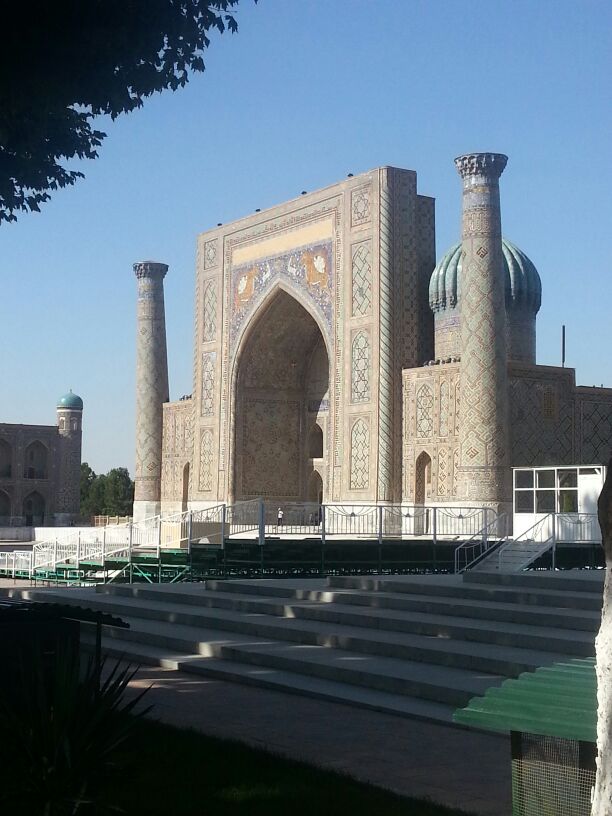
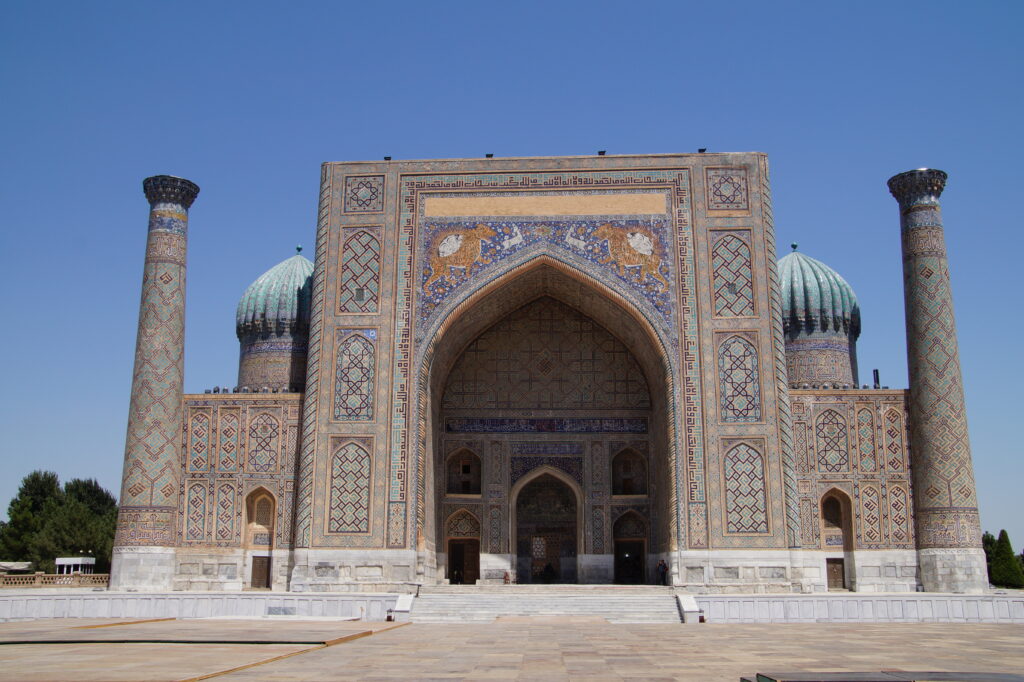
The Old Silk Road ran through Uzbekistan, an important network of trade routes to and from China. Along this route, luxury goods such as porcelain and even gold were traded extensively. This trade has left clear traces in Uzbekistan. Major cities were able to build magnificent, colorful structures. In Tashkent, for example, there are various religious buildings decorated with the famous blue mosaics. Further west lies the richest city of the Old Silk Road: Samarkand. Here you’ll find the famous Registan, a gigantic square with stunning mosaics. Incredible mausoleums and mosques were also built here—a place you simply can’t miss. In the far west, the buildings are less restored and it feels more authentic. Good examples are the blue cities of Bukhara and Khiva.

Geography and climate
From dry deserts to fertile valleys
Uzbekistan sits in the heart of Central Asia. The far west of the country is dominated by desert: the Kyzylkum and the Aral Kum. The Kyzylkum Desert is home to unique wildlife, while the Aral Kum is what remains of the once-vastly named “Aral Sea”, now reduced to a dry, sandy basin with haunting relics of the past. Further in the west of Uzbekistan lies the bigger cities of Khiva, Bukhara, Samarkand and Tashkent, which are build closely to a source of water – the source of life.
Further east, the country reveals its greener side. The Fergana Valley, often called the breadbasket of Central Asia, is a lush region of fertile soil and endless fruit gardens. In summer, it’s common to see trucks overflowing with watermelons — a remarkable sight! The valley also offers outdoor adventures such as mountain biking, rafting, and trekking.
Summers in Uzbekistan are hot, with temperatures in the cities often reaching 40°C. Thankfully, air conditioning is widely available in hotels and even train stations. Winters, however, can be bitterly cold due to it’s land climate — perfect for skiing in the eastern mountains. Luckly for us, Uzbekistan has skiing areas! Just outside Tashkent, the slopes of Chimgan and Beldersay attract winter sports enthusiasts.

Population
The hospitality of Uzbekistan
The people of Uzbekistan are renowned for their warmth and hospitality. Visitors are often greeted with a smile, a cup of tea, and sweet treats. While many locals don’t speak much English, they’ll always try to strike up a conversation. Uzbek and Russian are the main languages spoken. Originally of Turkic descent, Uzbeks were once nomadic, later settling in fertile areas to establish cities across the region. Islam is the dominant religion, though not practiced in a strictly conservative way. Women wear beautifully colored dresses without full face coverings, and men enjoy a glass of alcohol without any stigma.

Economy and tourism
Merchants at heart
Though the ancient Silk Road no longer exists, the trading spirit of Uzbeks is still very much alive. Since the invention of larger seagoing ships, it has become more efficient to transport goods by sea. Luckly, that doesn’t change the mindset of these people. Wandering through local markets, you’ll quickly notice that bargaining is a serious skill here. Today, Uzbekistan is part of the “New Silk Road” — a modern rail link between China and Europe, initiated by China’s government. Agriculture in the Fergana Valley continues to play a major role in the economy, alongside exports such as wine, dried fruits, rice, cotton, leather, and of course, silk. Inflation has been an ongoing issue in recent years, with the exchange rate fluctuating. Currently, around 10,000 SUM equals €1 — so withdrawing cash can make you feel like a millionaire!
Since the fall of the Soviet Union, Uzbekistan has become one of the most popular tourist destinations in Central Asia. Improved transport connections, better roads, and accessible public transport have made traveling here much easier. Tourism generally falls into three categories: cultural, adventure, and religious.
Cultural tourism: mosques and richly decorated buildings with intricate mosaics spread across the country.
Adventure tourism: outdoor activities in the Fergana Valley, from rafting to trekking.
Pilgrimage tourism: rooted in religious landmarks connected to Islam, but also Buddhism and Hinduism.